Again Tradition Says That Mary and Martha Visited Lazarus in Larnaca
Lazarus was a close friend of Christ, from Bethany, well-nigh three kilometers due east of Jerusalem. He lived in that location with his sisters Mary and Martha, and they frequently gave hospitality to Jesus (Luke 10:38-40; John 12:ane-three).
John the Evangelist informs us (John eleven) how i mean solar day Jesus was notified of the decease of Lazarus. Four days later He arrived in Bethany, not only to bring comfort to Lazarus' grieving sisters, but to prove the power of God and perform His greatest phenomenon by raising him from the dead, in anticipation of His own resurrection.
The resurrection of Lazarus brought brusk-lived great admiration and fame to Jesus, as evidenced by his triumphant entry into Jerusalem, only information technology also provoked great acrimony amid the teachers of the Law. Now they wanted both Jesus and Lazarus dead. Lazarus escaped, but Jesus did non. But what happened to Lazarus?
Co-ordinate to St. Epiphanios of Cyprus (367-403), Lazarus was thirty years onetime when 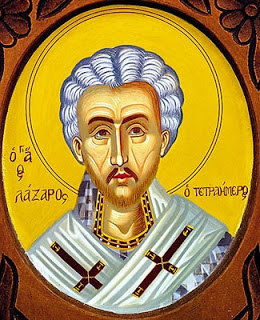 he rose from the expressionless, and so went on to live some other xxx years following his resurrection. Another tradition says that Lazarus fled the anger of the Jews and took refuge at Kition in Republic of cyprus around 33 A.D.
While in Cyprus, Lazarus met the apostles Paul and Barnabas, as they were traveling from Salamis to Paphos, and they ordained him the first Bishop of Kition. He shepherded the Church building of Kition with great care and love for eighteen years until the end of his life.
There are traditions which say he was sullen and never smiled after his resurrection, and this was due to what he saw while his soul was in Hades for four days. Some say he never once laughed, except one fourth dimension when he saw a homo steal a clay vessel, and he uttered the post-obit saying: "I world steals another".
Other Traditions Almost Lazarus
Another tradition connects him with Aliki in Larnaca (today'southward Kition). In Aliki at that time was a large vineyard. As the Saint was walking by he saw an old woman filling her basket with grapes. Tired and thirsty, the Saint asked the old woman for a few grapes. However, she looked at him with disdain and said:
"Become to hell, man. Tin can you not see that the vine is dried up like salt, and you are request me for grapes?"
"If yous run across it dried up similar salt, then let it become salt," responded Lazarus.
In this way the entire vineyard became a salt marsh.
Workers who collect common salt in this area today ostend this tradition. They claim to find when they dig there roots and trunks of vines. Information technology is said that in the middle of the salt lake today there is a well of fresh h2o, known every bit "the well of the one-time woman".
The Synaxarion of Constantinople, speaking of this tradition, says that the lake was claimed by two brothers, who broke ties for its possession. To end the dispute, the Saint by his prayers dried up the lake and information technology remained salty.
Another tradition says that the Theotokos came to Kition with John the Evangelist in order to meet Lazarus. St. John gave him clerical vestments and cuffs, and and so they went to Mount Athos.
The Second Death of Lazarus
St. Lazarus ended his 2nd earthly life at Cyprus in 63 A.D. The faithful wept and buried him with honors in a sarcophagus made of Cypriot marble, on which they wrote in Hebrew:
"Lazarus of the four days and the friend of Christ."
Above the sarcophagus there was congenital a beautiful church, which was renovated in 1750.
His memory is celebrated by the Church every Sabbatum earlier Palm Sunday.
The transfer of the relic of St. Lazarus from Kition to Constantinople, which took place in 890 by gild of Emperor Leo Half dozen the Wise is celebrated on October 17th. Emperor Leo wrote the idiomelon for the Vespers of St. Lazarus.
The Relic of St. Lazarus in Constantinople
The transfer of the relic of St. Lazarus is detailed for us in 2 pane 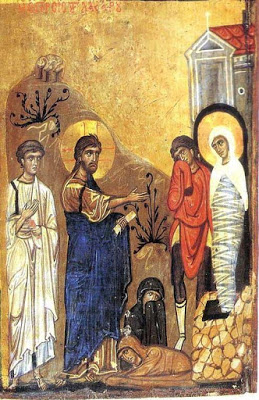 gyric homilies delivered by Bishop Arethas of Ceasarea (850-after 932). After extolling the arrival of this nifty treasure to Constantinople in his first homily, he describes in the 2nd the procession formed with the presence of the Emperor when the relic arrived from Chrysoupolis to Hagia Sophia. In substitution for this transfer, Leo Half-dozen sent money and artisans to Republic of cyprus, where he built a magnificent church to accolade St. Lazarus, which is maintained until today in Larnaca. Furthermore, he congenital a monastery in Constantinople dedicated to St. Lazarus, in which he placed the sacred relic. To this same monastery was later transferred the relic of St. Mary Magdalene from Ephesus. It later became a custom for the Emperor of New Rome to worship at the monastery on the Saturday of Lazarus.
Non too many years ago (specifically November 23, 1972) the superintendent of the Department of Antiquities, who worked towards the restoration of the church in Larnaca, found a sarcophagus with bones beneath the pillar supporting the plate of the Holy Altar. The basic were in a wooden box, placed in the sarcophagus, which in turn had carved on it the word "friend".
This finding seems to ostend the tradition that Leo Half-dozen did not take the unabridged relic of St. Lazarus to Constantinople, but left a portion behind. Accurate testimony and testify for this fact is the location where the basic were found: under the Holy Altar.
Moreover, Arethas does not mention an incorrupt relic, but "basic" and "pulverisation". Also, a Russian source at the library of Oxford reports that a Russian monk came from Pskov Monastery in the 16th century to Larnaca, and he venerated the basic of St. Lazarus, taking a pocket-size piece for himself as well. This piece is preserved till this day in the Chapel of Saint Lazarus at Pskov Monastery. Based on this account, we can affirm that the relic of St. Lazarus was venerated in Larnaca in the 16th century. A later account is not known, so for some reason, probably for protection, the Kitians hid the relic beneath the Holy Chantry until it was discovered in 1972.
penningtonwiffluelly.blogspot.com
Source: https://www.pravmir.com/what-happened-to-lazarus-after-his-resurrection/
0 Response to "Again Tradition Says That Mary and Martha Visited Lazarus in Larnaca"
Post a Comment