Why Does Pliny the Elder Not Sail Away Again After Arriving in Stabiae
| Pliny the Elderberry | |
|---|---|
 Statue of Pliny the Elder on the facade of Cathedral of S. Maria Maggiore in Como | |
| Born | AD 23 or 24 Novum Comum (Como), Roman Italia, Roman Empire |
| Died | AD 79 (aged 55) Stabiae, Roman Italy, Roman Empire |
| Citizenship | Roman |
| Teaching | Rhetoric, grammar |
| Occupation | Lawyer, writer, natural philosopher, naturalist, armed forces commander, provincial governor |
| Notable work | Naturalis Historia |
| Children | Pliny the Younger (nephew, later adopted son) |
| Parent(s) | Gaius Plinius Celer and Marcella |
Gaius Plinius Secundus (Advertisement 23/24 – 79), called Pliny the Elder (),[1] was a Roman author, naturalist and natural philosopher, and naval and army commander of the early Roman Empire, and a friend of the emperor Vespasian. He wrote the encyclopedic Naturalis Historia (Natural History), which became an editorial model for encyclopedias. He spent most of his spare time studying, writing, and investigating natural and geographic phenomena in the field.
His nephew, Pliny the Younger, wrote of him in a letter to the historian Tacitus:
For my function I deem those blessed to whom, past favour of the gods, it has been granted either to do what is worth writing of, or to write what is worth reading; in a higher place measure blest are those on whom both gifts have been conferred. In the latter number volition be my uncle, by virtue of his own and of your compositions.[2]
Among Pliny's greatest works was the xx-volume work Bella Germaniae ("The History of the German language Wars"), which is no longer extant. Bella Germaniae, which began where Aufidius Bassus' Libri Belli Germanici ("The War with the Germans") left off, was used every bit a source by other prominent Roman historians, including Plutarch, Tacitus and Suetonius. Tacitus—who many scholars hold had never travelled in Germania—used Bella Germaniae as the primary source for his work, De origine et situ Germanorum ("On the Origin and Situation of the Germans").[three]
Pliny the Elder died in AD 79 in Stabiae while attempting the rescue of a friend and his family by ship from the eruption of Mount Vesuvius, which had already destroyed the cities of Pompeii and Herculaneum.[4] The wind acquired past the sixth and largest pyroclastic surge of the volcano's eruption did not allow his transport to leave port, and Pliny died during that event.[5]
Life and times [edit]
Groundwork [edit]
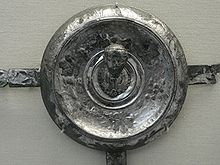
One of the Xanten Equus caballus-Phalerae located in the British Museum, measuring ten.5 cm (4.1 in).[6] It bears an inscription formed from punched dots: PLINIO PRAEF EQ; i.e., Plinio praefecto equitum, "Pliny prefect of cavalry". It was perhaps issued to every human in Pliny's unit of measurement. The figure is the bust of the emperor.
Pliny's dates are pinned to the eruption of Mount Vesuvius in AD 79 and a statement by his nephew that he died in his 56th year, which would put his birth in Advertizement 23 or 24.
Pliny was the son of an equestrian Gaius Plinius Celer and his wife Marcella. Neither the younger nor the elderberry Pliny mention the names. Their ultimate source is a fragmentary inscription (CIL V 1 3442) found in a field in Verona and recorded past the 16th-century Augustinian monk Onofrio Panvinio. The form is an elegy. The near commonly accepted reconstruction is
PLINIVS SECVNDVS AVGV. LERI. PATRI. MATRI. MARCELLAE. TESTAMENTO FIERI IVSSO
Plinius Secundus augur ordered this to be made as a testament to his father [Ce]ler and his female parent [Grania] Marcella
The actual words are fragmentary. The reading of the inscription depends on the reconstruction,[vii] merely in all cases the names come through. Whether he was an augur and whether she was named Grania Marcella are less certain.[8] Jean Hardouin presents a statement from an unknown source that he claims was aboriginal, that Pliny was from Verona and that his parents were Celer and Marcella.[nine] Hardouin too cites the conterraneity (meet below) of Catullus.[7]
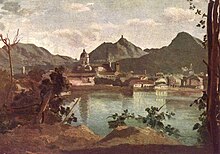
How the inscription got to Verona is unknown, just it could accept arrived by dispersal of property from Pliny the Younger'southward then Tuscan (now Umbrian) estate at Colle Plinio, north of Città di Castello, identified with certainty by his initials in the roof tiles. He kept statues of his ancestors there. Pliny the Elder was built-in at Como, non at Verona: information technology is only every bit a native of quondam Gallia Transpadana that he calls Catullus of Verona his conterraneus, or fellow-countryman, not his municeps, or swain-townsman.[10] [11] A statue of Pliny on the façade of the Como Cathedral celebrates him as a native son. He had a sister, Plinia, who married into the Caecilii and was the female parent of his nephew, Pliny the Younger, whose letters describe his work and study regimen in detail.
In one of his letters to Tacitus (avunculus meus), Pliny the Younger details how his uncle's breakfasts would be calorie-free and unproblematic (levis et facilis) following the customs of our forefathers (veterum more interdiu). Pliny the Younger wanted to convey that Pliny the Elder was a "practiced Roman", which means that he maintained the customs of the great Roman forefathers. This statement would have pleased Tacitus.
Two inscriptions identifying the hometown of Pliny the Younger as Como accept precedence over the Verona theory. One (CIL 5 5262) commemorates the younger's career as the majestic magistrate and details his considerable charitable and municipal expenses on behalf of the people of Como. Another (CIL V 5667) identifies his begetter Lucius' hamlet as present-solar day Fecchio (tribe Oufentina), a hamlet of Cantù, well-nigh Como. Therefore, Plinia likely was a local girl and Pliny the Elder, her brother, was from Como.[12]
Gaius was a member of the Plinia gens: the Insubric root Plina still persists, with rhotacism, in the local surname "Prina". He did not take his father'south cognomen, Celer, but causeless his own, Secundus. As his adopted son took the same cognomen, Pliny founded a co-operative, the Plinii Secundi. The family was prosperous; Pliny the Younger's combined inherited estates made him so wealthy that he could plant a school and a library, endow a fund to feed the women and children of Como, and own multiple estates effectually Rome and Lake Como, besides as enrich some of his friends as a personal favor. No before instances of the Plinii are known.
In 59 BC, merely about 82 years before Pliny'southward birth, Julius Caesar founded Novum Comum (reverting to Comum) as a colonia to secure the region against the Alpine tribes, whom he had been unable to defeat. He imported a population of 4,500 from other provinces to exist placed in Comasco and 500 aloof Greeks to found Novum Comum itself.[13] The community was thus multi-ethnic and the Plinies could have come from anywhere. Whether whatsoever conclusions can exist fatigued from Pliny'due south preference for Greek words, or Julius Pokorny's derivation of the proper noun from north Italic equally "bald"[14] is a matter of speculative opinion. No record of any ethnic distinctions in Pliny's time is apparent—the population considered themselves to be Roman citizens.
Pliny the Elder did not marry and had no children. In his volition, he adopted his nephew, which entitled the latter to inherit the unabridged estate. The adoption is chosen a "testamental adoption" by writers on the topic[ who? ], who assert that it applied to the proper name modify[what name modify?] only, simply Roman jurisprudence recognizes no such category. Pliny the Younger thus became the adopted son of Pliny the Elder after the latter'southward death.[15] For at least some of the fourth dimension, still, Pliny the Elder resided in the aforementioned house in Misenum with his sister and nephew (whose married man and begetter, respectively, had died young); they were living there when Pliny the Elder decided to investigate the eruption of Mount Vesuvius, and was sidetracked past the demand for rescue operations and a messenger from his friend asking for aid.
Student and lawyer [edit]
Pliny'southward begetter took him to Rome to be educated in lawmaking.[16] Pliny relates that he saw Marcus Servilius Nonianus.
Junior officer [edit]
In Advertizing 46, at about age 23, Pliny entered the army equally a junior officer, as was the custom for immature men of equestrian rank. Ronald Syme, Plinian scholar, reconstructs iii periods at iii ranks.[17] [xviii] Pliny's interest in Roman literature attracted the attention and friendship of other men of letters in the college ranks, with whom he formed lasting friendships. Afterward, these friendships assisted his entry into the upper echelons of the state; however, he was trusted for his knowledge and ability, as well. Co-ordinate to Syme, he began as a praefectus cohortis, a "commander of a accomplice" (an infantry cohort, as junior officers began in the infantry), under Gnaeus Domitius Corbulo, himself a author (whose works did not survive) in Germania Junior. In AD 47, he took office in the Roman conquest of the Chauci and the structure of the canal between the rivers Maas and Rhine.[16] His clarification of the Roman ships anchored in the stream overnight having to ward off floating trees has the postage of an bystander business relationship.[19]

Map of Castra Vetera, a large permanent base (castra stativa) of Germania Inferior, where Pliny spent the last of his x-year term as a cavalry commander: The proximity of a naval base there means that he trained also in ships, as the Romans customarily trained all soldiers in all artillery whenever possible. The location is on the lower Rhine River.
At some uncertain date, Pliny was transferred to the command of Germania Superior nether Publius Pomponius Secundus with a promotion to military tribune,[17] which was a staff position, with duties assigned past the commune commander. Pomponius was a half-brother of Corbulo.[twenty] They had the same mother, Vistilia, a powerful matron of the Roman upper classes, who had vii children by half-dozen husbands, some of whom had regal connections, including a future empress. Pliny's assignments are non clear, only he must accept participated in the campaign against the Chatti of Advertising 50, at age 27, in his quaternary year of service. Associated with the commander in the praetorium, he became a familiar and shut friend of Pomponius, who as well was a human being of letters.
At some other uncertain date, Pliny was transferred back to Germania Inferior. Corbulo had moved on, assuming command in the east. This time, Pliny was promoted to praefectus alae, "commander of a wing", responsible for a cavalry battalion of about 480 men.[21] He spent the remainder of his military service in that location. A decorative phalera, or piece of harness, with his name on information technology has been found at Castra Vetera, modern Xanten, then a large Roman army and naval base on the lower Rhine.[17] Pliny'southward final commander there, apparently neither a man of messages nor a close friend of his, was Pompeius Paullinus, governor of Germania Junior Ad 55–58.[22] Pliny relates that he personally knew Paulinus to have carried around 12,000 pounds of silver service on which to dine in a campaign against the Germans (a practice which would non accept endeared him to the disciplined Pliny).[23]
According to his nephew,[21] during this menses, he wrote his first book (perhaps in winter quarters when more spare fourth dimension was bachelor), a work on the apply of missiles on horseback, De Jaculatione Equestri ("On the Use of the Dart by Cavalry").[16] Information technology has non survived, but in Natural History, he seems to reveal at least office of its content, using the movements of the horse to assist the javelin-human in throwing missiles while astride its back.[24] During this period, he besides dreamed that the spirit of Drusus Nero begged him to salvage his memory from oblivion.[21] The dream prompted Pliny to brainstorm forthwith a history of all the wars between the Romans and the Germans,[16] which he did not consummate for some years.
Literary interlude [edit]
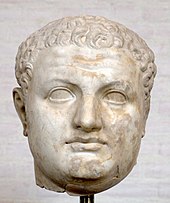
At the earliest time Pliny could have left the service, Nero, the concluding of the Julio-Claudian dynasty, had been emperor for ii years. He did not leave role until AD 68, when Pliny was 45 years old. During that time, Pliny did non hold whatsoever high role or work in the service of the state. In the subsequent Flavian dynasty, his services were in such need that he had to give up his constabulary practice, which suggests that he had been trying not to attract the attention of Nero, who was a dangerous acquaintance.
Nether Nero, Pliny lived mainly in Rome. He mentions the map of Armenia and the neighbourhood of the Caspian Bounding main, which was sent to Rome past the staff of Corbulo in 58.[25] [sixteen] He also witnessed the construction of Nero'southward Domus Aurea or "Golden House" after the Great Fire of Rome in 64.[26]
Likewise pleading law cases, Pliny wrote, researched, and studied. His second published piece of work was "The Life of Pomponius Secundus," a 2-volume biography of his quondam commander, Pomponius Secundus.[21]
Meanwhile, he was completing his monumental piece of work Bella Germaniae, the simply authorization expressly quoted in the first half-dozen books of the Annales of Tacitus,[xvi] and probably ane of the chief authorities for the aforementioned author'south Germania.[3] Information technology disappeared in favor of the writings of Tacitus (which are far shorter), and, early in the fifth century, Symmachus had petty hope of finding a copy.[27]
Like Caligula, Nero seemed to abound gradually more insane as his reign progressed. Pliny devoted much of his time to writing on the comparatively safety subjects of grammer and rhetoric.[16] He published a 3-book, six-volume educational manual on rhetoric, entitled Studiosus, "The Student". Pliny the Younger says of it: "The orator is trained from his very cradle and perfected."[21] Information technology was followed past viii books entitled Dubii sermonis,[16] "Of Doubtful Phraseology". These are both now lost works. His nephew relates: "He wrote this under Nero, in the last years of his reign, when every kind of literary pursuit which was in the least contained or elevated had been rendered unsafe by servitude."
In 68, Nero no longer had whatsoever friends and supporters. He committed suicide, and the reign of terror was at an end, every bit was the interlude in Pliny'south obligation to the state.
Senior officer [edit]
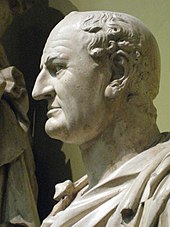
At the end of AD 69, afterwards a year of civil state of war consistent on the death of Nero, Vespasian, a successful full general, became emperor. Like Pliny, he had come from the equestrian grade, rising through the ranks of the regular army and public offices and defeating the other contenders for the highest part. His main tasks were to re-establish peace under imperial command and to identify the economy on a sound footing. He needed in his administration all the loyalty and assistance he could notice. Pliny, evidently trusted without question, possibly (reading between the lines) recommended by Vespasian's son Titus, was put to work immediately and was kept in a continuous succession of the most distinguished procuratorships, according to Suetonius.[28] A procurator was mostly a governor of an imperial province. The empire was perpetually short of, and was ever seeking, officeholders for its numerous offices.
Throughout the latter stages of Pliny's life, he maintained good relations with Emperor Vespasian. As is written in the outset line of Pliny the Younger's Avunculus Meus:
Ante lucem ibat advertising Vespasianum imperatorem (nam ille quoque noctibus utebatur), deinde ad officium sibi delegatum .
Before dawn he was going to Emperor Vespasian (for he also made utilize of the dark), then he did the other duties assigned to him.
In this passage, Pliny the Younger conveys to Tacitus that his uncle was ever the academic, always working. The word ibat (imperfect, "he used to become") gives a sense of repeated or customary action. In the subsequent text, he mentions again how almost of his uncle's twenty-four hours was spent working, reading, and writing. He notes that Pliny "was indeed a very ready sleeper, sometimes dropping off in the middle of his studies and then waking upwards once more."[29]
A definitive report of the procuratorships of Pliny was compiled by the classical scholar Friedrich Münzer, which was reasserted past Ronald Syme and became a standard reference point. Münzer hypothesized four procuratorships, of which two are certainly attested and two are probable just not certain. Withal, two does not satisfy Suetonius' description of a continuous succession.[30] Consequently, Plinian scholars present 2 to four procuratorships, the four comprising (i) Gallia Narbonensis in 70, (2) Africa in 70–72, (iii) Hispania Tarraconensis in 72–74, and (four) Gallia Belgica in 74–76.
According to Syme, Pliny may have been "successor to Valerius Paulinus", procurator of Gallia Narbonensis (southeastern France), early in AD 70. He seems to have a "familiarity with the provincia", which, all the same, might otherwise be explained.[31] For example, he says[32]
In the cultivation of the soil, the manners and civilization of the inhabitants, and the extent of its wealth, it is surpassed past none of the provinces, and, in curt, might exist more truthfully described as a function of Italian republic than as a province.
denoting a general popular familiarity with the region.

Pliny certainly spent some time in the province of Africa, most likely equally a procurator.[33] Amid other events or features that he saw are the provoking of rubetae, poisonous toads (Bufonidae), by the Psylli;[34] the buildings made with molded earthen walls, "superior in solidity to any cement;"[35] and the unusual, fertile seaside oasis of Gabès (then Tacape), Tunisia, currently a World Heritage Site.[36] Syme assigns the African procuratorship to AD 70–72.
The procuratorship of Hispania Tarraconensis was side by side. A statement by Pliny the Younger that his uncle was offered 400,000 sesterces for his manuscripts by Larcius Licinius while he (Pliny the Elderberry) was procurator of Hispania makes it the most certain of the three.[21] Pliny lists the peoples of "Here Hispania", including population statistics and borough rights (modern Asturias and Gallaecia). He stops short of mentioning them all for fear of "wearying the reader".[37] Equally this is the only geographic region for which he gives this information, Syme hypothesizes that Pliny contributed to the census of Hither Hispania conducted in 73/74 by Vibius Crispus, legate from the Emperor, thus dating Pliny's procuratorship there.[38]
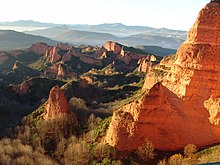
During his stay in Hispania, he became familiar with the agronomics and especially the gold mines of the north and w of the land.[39] His descriptions of the various methods of mining appear to be eyewitness judging by the discussion of gold mining methods in his Natural History. He might take visited the mine excavated at Las Médulas.
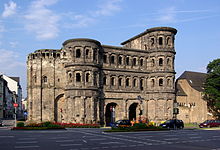
The last position of procurator, an uncertain one, was of Gallia Belgica, based on Pliny'southward familiarity with it. The uppercase of the province was Augusta Treverorum (Trier), named for the Treveri surrounding it. Pliny says that in "the year but one before this" a severe wintertime killed the first crops planted by the Treviri; they sowed again in March and had "a most arable harvest."[40] The problem is to identify "this", the year in which the passage was written. Using 77 equally the date of composition Syme[41] arrives at AD 74–75 as the date of the procuratorship, when Pliny is presumed to have witnessed these events. The argument is based entirely on presumptions; yet, this engagement is required to achieve Suetonius' continuity of procuratorships, if the one in Gallia Belgica occurred.
Pliny was allowed habitation (Rome) at some time in AD 75–76. He was presumably at home for the first official release of Natural History in 77. Whether he was in Rome for the dedication of Vespasian'due south Temple of Peace in the Forum in 75, which was in essence a museum for display of art works plundered by Nero and formerly adorning the Domus Aurea, is uncertain, every bit is his possible command of the vigiles (night watchmen), a lesser mail. No bodily post is discernible for this period. On the bare circumstances, he was an official agent of the emperor in a quasiprivate chapters. Perhaps he was between posts. In any instance, his engagement equally commander of the imperial armada at Misenum[42] took him there, where he resided with his sister and nephew. Vespasian died of illness on 23 June 79. Pliny outlived him by ii months.
[edit]
During Nero'south reign of terror, Pliny avoided working on any writing that would attract attention to himself. His works on oratory in the last years of Nero'southward reign (67, 68) focused on form rather than on content. He began working on content over again probably after Vespasian'southward dominion began in AD 69, when the terror clearly was over and would not exist resumed. It was to some degree reinstituted (and later cancelled by his son Titus) when Vespasian suppressed the philosophers at Rome, but non Pliny, who was non amidst them, representing, as he says, something new in Rome, an encyclopedist (certainly, a venerable tradition outside Italy).[ commendation needed ]
In his adjacent work, Bella Germaniae, Pliny completed the history which Aufidius Bassus left unfinished. Pliny's continuation of Bassus'due south History was one of the authorities followed past Suetonius and Plutarch.[xvi] Tacitus besides cites Pliny as a source. He is mentioned apropos the loyalty of Burrus, commander of the Praetorian Guard, whom Nero removed for disloyalty.[43] Tacitus portrays parts of Pliny's view of the Pisonian conspiracy to kill Nero and make Piso emperor as "absurd"[44] and mentions that he could not make up one's mind whether Pliny's account or that of Messalla was more accurate concerning some of the details of the Year of the Four Emperors.[45] Evidently Pliny'due south extension of Bassus extended at least from the reign of Nero to that of Vespasian. Pliny seems to have known information technology was going to be controversial, equally he deliberately reserved it for publication after his decease:[sixteen]
It has been long completed and its accurateness confirmed; but I accept determined to commit the charge of it to my heirs, lest I should have been suspected, during my lifetime, of having been disproportionately influenced by ambition. Past this means I confer an obligation on those who occupy the same ground with myself; and also on posterity, who, I am aware, will contend with me, equally I have done with my predecessors.[46]
Natural History [edit]
Pliny's concluding piece of work, according to his nephew, was the Naturalis Historia (Natural History), an encyclopedia into which he collected much of the noesis of his fourth dimension.[21] Some historians consider this to be the offset encyclopedia written.[47] Information technology comprised 37 books. His sources were personal experience, his ain prior works (such as the work on Germania), and extracts from other works. These extracts were collected in the following fashion: One servant would read aloud, and another would write the extract as dictated by Pliny. He is said to accept dictated extracts while taking a bath. In winter, he furnished the copier with gloves and long sleeves so his writing hand would not stiffen with cold (Pliny the Younger in avunculus meus). His extract collection finally reached near 160 volumes, which Larcius Licinius, the Praetorian legate of Hispania Tarraconensis, unsuccessfully offered to purchase for 400,000 sesterces. [21] That would have been in 73/74 (encounter above). Pliny bequeathed the extracts to his nephew.
When composition of Natural History began is unknown. Since he was preoccupied with his other works under Nero so had to cease the history of his times, he is unlikely to have begun earlier 70. The procuratorships offered the ideal opportunity for an encyclopedic frame of mind. The date of an overall composition cannot be assigned to whatsoever one year. The dates of different parts must be determined, if they can, past philological analysis (the postal service mortem of the scholars).

The closest known event to a single publication date, that is, when the manuscript was probably released to the public for borrowing and copying, and was probably sent to the Flavians, is the appointment of the Dedication in the outset of the 37 books. Information technology is to the imperator Titus. As Titus and Vespasian had the aforementioned name, Titus Flavius Vespasianus, earlier writers hypothesized a dedication to Vespasian. Pliny'due south mention of a brother (Domitian) and joint offices with a father, calling that male parent "great", points certainly to Titus.[48]
Pliny also says that Titus had been consul six times.[49] The first six consulships of Titus were in lxx, 72, 74, 75, 76, and 77, all conjointly with Vespasian, and the seventh was in 79. This brings the date of the Dedication probably to 77. In that year, Vespasian was 68. He had been ruling conjointly with Titus for some years.[48] The title imperator does not indicate that Titus was sole emperor, only was awarded for a military victory, in this example that in Jerusalem in 70.[50]
Aside from modest finishing touches, the work in 37 books was completed in AD 77.[51] That it was written entirely in 77 or that Pliny was finished with it then cannot be proved. Moreover, the dedication could have been written earlier publication, and it could have been published either privately or publicly earlier without the dedication. The but certain fact is that Pliny died in AD 79.
Natural History is one of the largest single works to have survived from the Roman Empire and was intended to cover the unabridged field of ancient knowledge, based on the all-time authorities available to Pliny. He claims to be the only Roman ever to have undertaken such a work. Information technology encompasses the fields of phytology, zoology, astronomy, geology, and mineralogy, as well as the exploitation of those resource. Information technology remains a standard work for the Roman period and the advances in applied science and agreement of natural phenomena at the time. His discussions of some technical advances are the only sources for those inventions, such as hushing in mining technology or the use of h2o mills for crushing or grinding grain. Much of what he wrote nearly has been confirmed past archæology. It is nearly the only work that describes the work of artists of the time, and is a reference work for the history of art. As such, Pliny's approach to describing the work of artists informed Lorenzo Ghiberti in writing his commentaries in the 15th century, and Giorgio Vasari, who wrote the historic Lives of the Near Fantabulous Painters, Sculptors, and Architects in 1550.
Natural History as the Commencement Encyclopedia [edit]
Some historians consider Natural History to be the kickoff encyclopedia e'er written.[47] It was the primeval encyclopedia to survive. There were many ancient histories written before Pliny the Elder'south Natural History, but scholars nevertheless recognize Natural History as an encyclopedia, setting it apart from the other aboriginal histories. Regardless of if it was first, it is certainly the most pregnant. Through Natural History, Pliny the Elder gives modern experts a view into meanings of diverse things from starting time century Rome in a way that no other surviving text does.[52] Each book of the Natural History covers a different topic, and the work is meant to encompass every topic. Given the system of the piece of work, it is clear that it was meant to be a reference resource.[52] Even mod scholars will sometimes compare an unknown object mentioned in a unlike aboriginal text with the objects described past Pliny and make comparisons. Modern scholars are besides able to utilize Natural History to understand the traditions, fantasies, and prejudices in Ancient Rome. Some people[ who? ] have said that certain prejudices that accept been prevalent throughout western history (such as a stigma around menstruation) were spread by Natural History.
The work became a model for all later encyclopedias in terms of the breadth of subject matter examined, the need to reference original authors, and a comprehensive index list of the contents. Information technology is the only work past Pliny to have survived, and the last that he published, lacking a concluding revision at his sudden and unexpected death in the Advertizing 79 eruption of Mount Vesuvius.
Expiry [edit]

Plaster casts of the casualties from pyroclastic surges, whose remains vanished, leaving cavities in the pumice at Pompeii
Pliny, who had been appointed praefectus classis in the Roman navy past Vespasian, was stationed with the fleet at Misenum at the time of the eruption of Mount Vesuvius.[42] He organized and led a rescue mission upon receiving a message from his friend Rectina, who had been left stranded in Stabiae during the eruption. Pliny boarded one of several galleys that he dispatched across the Gulf of Naples to Stabiae.[ii]
Every bit Pliny's vessel approached the shore virtually Herculaneum, cinders and pumice began to fall on information technology. The helmsman advised turning back, to which Pliny replied, "Fortune favours the bold; steer to where Pomponianus is." Upon reaching Stabiae, they found Senator Pomponianus, but the same winds that brought them there prevented them from leaving. The group waited for the current of air to abate, but they decided to leave later that evening for fear their houses would plummet. The group fled when a plume of hot toxic gases engulfed them. Pliny, a corpulent human who suffered from a chronic respiratory condition, possibly asthma, died from asphyxiation caused by the toxic gases, and was left backside. Upon the group'southward return 3 days later after the plume had dispersed, Pliny's trunk was constitute, with no apparent external injuries.[2]
20-seven years later, upon a request from Tacitus, Pliny the Younger provided an account (obtained from the survivors from Stabiae) of his uncle'southward decease.[2] [21] [sixteen] Suetonius wrote that Pliny approached the shore only from scientific interest and then asked a slave to kill him to avoid heat from the volcano.[53] In 1859 Jacob Bigelow, after summarizing the information near Pliny's death contained in Pliny the Younger's letter to Tacitus, concluded that Pliny had died from apoplexy (stroke) or middle affliction.[54] In 1967, science historian Conway Zirkle similarly stated that "there is widespread and persisting misinformation" most Pliny'southward decease. He suggested that despite his rescue endeavor, Pliny never came within miles of Mount Vesuvius and no evidence has been found that shows he died from breathing in fumes, and similar Bigelow, concluded that he died of a centre attack.[55]
See as well [edit]
- Plinian eruption
- Plinius, lunar crater
References [edit]
- ^ Melvyn Bragg (8 July 2010). "Pliny the Elderberry". In Our Time (Podcast). BBC Radio 4. Retrieved 26 January 2020.
- ^ a b c d Pliny the Younger. "Vi.16 To Tacitus". Messages.
- ^ a b Gudeman, Alfred (1900). "The Sources of the Germania of Tacitus". Transactions and Proceedings of the American Philological Association. 31: 93–111. doi:10.2307/282642. JSTOR 282642.
- ^ Katherine J. Wu (27 Jan 2020). "This 2,000-Year-Old Skull May Vest to Pliny the Elder". Smithsonian Magazine.
- ^ Francis, Peter & Oppenheimer, Clive (2004). Volcanoes. Oxford Academy Press. ISBN0-19-925469-9.
- ^ "Armed services horse trapping inscribed with the name of Pliny the Elder". The British Museum: Highlights. Archived from the original on 3 December 2013.
- ^ a b
- ^ And then as well is the further speculation by Metello that she was the daughter of Titus, which suggests a possible connection with the Titii Pomponii on his mother'southward side, and a connection with the Caecilii (Celer was a cognomen used by that Gens) on his male parent'due south side: Metello, Manuel Arnao; João Carlos Metello de Nápoles (1998). Metellos de Portugal, Brasil e Roma: compilações genealógicas (in Portuguese). Lisboa: Edição Nova Arrancada. ISBN978-972-8369-xviii-vii.
- ^ Allain, Eugène (1902). Pline le Jeune et ses héritiers (in French). Vol. 3 (ouvrage illustré d'environ 100 photogravures et de fifteen cartes ou plans ed.). A. Fontemoing. pp. 281–282.
- ^
 This commodity incorporates text from a publication now in the public domain:Charles Peter Mason (1870). "C. Plinius Secundus". In Smith, William (ed.). Dictionary of Greek and Roman Biography and Mythology. Vol. 3. p. 414.
 - ^ "I, Dedication". Natural History.
if I may be immune to shelter myself under the example of Catullus, my beau-countryman
- ^ Pliny the Younger; Betty Radice (Editor, Translator, Contributor) (1969). "Appendix A: Inscriptions". The letters of the younger Pliny (6, revised, reprint, reissue, illustrated ed.). Penguin Classics. ISBN978-0-fourteen-044127-vii. CS1 maint: multiple names: authors list (link)
- ^ Hardy, Ernest George (2007). "5 Caesar's Colony at Novum Comum in 59 BC". Some Bug in Roman History: Ten Essays Bearing on the Administrative and Legislative Work of Julius Caesar. The Lawbook Exchange, Ltd. pp. 126–149. ISBN978-1-58477-753-iii.
- ^ Pokorny, Julius. "Indogermanisches Etymologisches Woerterbuch" (in High german). University of Leiden. p. 834. Archived from the original on 27 September 2006.
- ^ Pliny the Younger; Constantine E. Prichard; Edward R. Bernard (Editors) (1896). Selected Letters. Oxford: Clarendon Press. p. 1. CS1 maint: multiple names: authors list (link)
- ^ a b c d e f g h i j grand One or more than of the preceding sentences incorporates text from a publication now in the public domain:Sandys, John Edwin (1911). "Pliny the Elder". In Chisholm, Hugh (ed.). Encyclopædia Britannica. Vol. 21 (11th ed.). Cambridge University Printing. pp. 841–844.
- ^ a b c Beagon (2005) p.3.
- ^ Syme (1969), p. 207.
- ^ "XVI.ii". Natural History.
Many is the time that these trees accept struck our fleets with alarm, when the waves take driven them, almost purposely information technology would seem, against their prows equally they stood at anchor in the nighttime; and the men, destitute of all remedy and resource, accept had to engage in naval combat with a woods of trees!
- ^ Levick, Barbara (1999). Tiberius the politician (2, revised, illustrated ed.). Routledge. p. 290. ISBN978-0-415-21753-8.
- ^ a b c d e f yard h i Pliny the Younger. "3.5 To Baebius Macer". Messages.
- ^ Griffin (1992), p. 438.
- ^ "XXXIII.50". Natural History.
to my ain cognition, Pompeius Paulinus... had with him, when serving with the army, and that, too, in a state of war against the most vicious nations, a service of silver plate that weighed twelve thousand pounds!
- ^ "VIII.65". Natural History.
Those who have to use the javelin are well aware how the horse, past its exertions and the supple movements of its trunk, aids the rider in whatsoever difficulty he may have in throwing his weapon.
- ^ "6.15". Natural History.
- ^ "XXXVI.24". Natural History.
- ^ Symmachus. "IV.xviii". Letters.
- ^ Syme (1969), p. 224.
- ^ Epistles, Iii v
- ^ Griffin (1992), p. 439.
- ^ Syme (1969), p. 225.
- ^ "III.v (.4)". Natural History.
- ^ Syme (1969), pp. 214-215.
- ^ "XXV.76". Natural History.
I myself have seen the Psylli, in their exhibitions, irritate them by placing them upon apartment vessels made red hot, their bite being fatal more than instantaneously than the sting even of the asp.
- ^ "XXXV.48 (fourteen.)". Natural History.
- ^ "XVIII.51". Natural History.
- ^ "3.4 (.3) Of Nearer Kingdom of spain". Natural History.
- ^ Syme (1969), p. 216.
- ^ "XXXIII.21". Natural History.
Asturia, Gallæcia, and Lusitania furnish in this mode, yearly, according to some authorities, twenty thousand pounds' weight of gold, the produce of Asturia forming the major part. Indeed, there is no part of the world that for centuries has maintained such a continuous fertility in golden.
- ^ "Eighteen.49 (.nineteen)". Natural History.
- ^ Syme (1969), p. 213.
- ^ a b Ariel David (31 August 2017). "Pompeii Hero Pliny the Elderberry May Have Been Found 2,000 Years Afterward". Haaretz. Tel Aviv.
- ^ Tacitus. "thirteen.20". The Register.
- ^ Tacitus. "15.53". The Annals.
- ^ Tacitus. "3.29". The Histories.
- ^ Pliny (1938). "Preface, xx". Natural History.
- ^ a b Dennis, J. (1995). "Pliny'due south World: All the Facts-and and so Some". Smithsonian. 26 (8): 152.
- ^ a b Beagon (2005), p. 7.
- ^ Gaius Plinius Secundus (1855). "Volume I:Dedication". The Natural History of Pliny. Vol. 1. Translated by John Bostock and Henry Thomas Riley. London: Henry Thou. Bohn.
You, who accept had the honour of a triumph, and of the censorship, take been half dozen times consul, and have shared in the tribunate....
- ^ "Roman Emperors - DIR Titus".
- ^ Jerry Stannard (1977). "Pliny the Elder - Roman scholar". The New Encyclopædia Britannica. Vol. 14 (15 ed.). p. 572a.
- ^ a b Irish potato, Trevor (2007). Pliny the Elder'due south Natural History: The Empire in the Encyclopedia. Oxford University Press. ISBN9780199262885.
- ^ Gaius Suetonius Tranquillus (1914). "The Life of Pliny the Elderberry". In Folio, T.E.; Rouse, William Henry Denham (eds.). Suetonius - The Lives of Illustrious Men. The Loeb Classical Library. Vol. Ii. New York: The Macmillan Visitor. pp. 504–5. ISBN9780674990425.
- ^ Bigelow, Jacob (1859). "On the Death of Pliny the Elder". Memoirs of the American Academy of Arts and Sciences. vi (ii): 223–seven. Bibcode:1859MAAAS...vi..223B. doi:10.2307/25057949. JSTOR 25057949.
- ^ Zirkle, Conway. (1967). The Death of Gaius Plinius Secundus (23-79 A.D.). Isis 58: 553-559.

Sources [edit]
- Beagon, Mary. (1992). Roman Nature: The Thought of Pliny the Elder. Oxford: Oxford Univ. Press.
- Beagon, Mary (translator) (2005). The elder Pliny on the human fauna: Natural History, Book 7. Oxford University press. ISBN0-xix-815065-2.
- Carey, Sorcha (2006). Pliny's Catalogue of Culture: Art and Empire in the Natural history. Oxford Academy printing. ISBN0-19-920765-eight.
- Doody, Aude. (2010). Pliny's Encyclopedia: The Reception of the Natural History. Cambridge, UK, and New York: Cambridge Univ. Printing.
- Griffin, Miriam Tamara (1992). Seneca: A Philosopher in Politics (reprint ed.). Oxford University Press. ISBN978-0-19-814774-nine.
- Fane-Saunders, Peter. (2016). Pliny the Elder and the Emergence of Renaissance Architecture. New York: Cambridge Academy Printing.
- French, Roger, and Frank Greenaway, eds. (1986). Science in the Early on Roman Empire: Pliny the Elder, His Sources and Influence. London: Croom Captain.
- Gibson, Roy and Ruth Morello eds. (2011). Pliny the Elder: Themes and Contexts. Leiden: Brill.
- Healy, John F. (1999). Pliny the Elder on science and applied science. Oxford University Press. ISBN0-xix-814687-6.
- Isager, Jacob (1991). Pliny on Art and Society: The Elder Pliny's Chapters on the History of Art. London & New York: Routledge. ISBN0-415-06950-5.
- Laehn, Thomas R. (2013). Pliny'south Defense of Empire. Routledge Innovations in Political Theory. New York: Routledge.
- Spud, Trevor (2004). Pliny the Elderberry'due south Natural History: the Empire in the Encyclopedia. Oxford University Press. ISBN0-nineteen-926288-8.
- Ramosino, Laura Cotta (2004). Plinio il Vecchio east la tradizione storica di Roma nella Naturalis historia (in Italian). Alessandria: Edizioni del'Orso. ISBN88-7694-695-0.
- Syme, Ronald (1969). "Pliny the Procurator". In Section of the Classics, Harvard Academy (ed.). Harvard studies in classical philology (illustrated ed.). Harvard University Press. pp. 201–236. ISBN978-0-674-37919-0.
- Pliny the Elder; William P. Thayer (contributor). "Pliny the Elder: the Natural History" (in Latin and English). Academy of Chicago. Retrieved 24 May 2009.
- Pliny the Elder (1855). "The Natural History". John Bostock, Henry Thomas Riley (translators and editors); Gregory R. Crane (Chief editor). Taylor and Francis; Tufts University: Perseus Digital Library. Retrieved 24 May 2009.
- Fisher, Richard V. "Derivation of the name 'Plinian'". Academy of California at Santa Barbara: The Volcano Information Center.
Secondary cloth [edit]
- Lendering, Jona (1996–2009). "Pliny the Elder (1)". Livius Manufactures on Ancient History. Retrieved 15 May 2009.
- Lendering, Jona (1996–2009). "Pliny the Elderberry (2)". Livius Articles on Ancient History. Retrieved 15 May 2009.
- Pearse, Roger (2013). "The manuscripts of Pliny the Elderberry". Tertullian.org. Retrieved 22 June 2013.
External links [edit]
penningtonwiffluelly.blogspot.com
Source: https://en.wikipedia.org/wiki/Pliny_the_Elder
0 Response to "Why Does Pliny the Elder Not Sail Away Again After Arriving in Stabiae"
Post a Comment